
|
Short answer: Glue volume drifts because viscosity, air pressure and the condition of the needle change during a shift, and an open-loop dispenser cannot see any of it. A closed-loop cell weighs shots at set intervals, measures height with a laser before dispensing, recalibrates the needle with vision after every change, and cleans the tip automatically. Together these catch drift before it reaches the product. |
Most dispensing problems are found too late. A short bead shows up at final inspection, a missed dot is found by the customer, or a needle hits the part after a changeover and scraps a board. In every case, the machine dispensed exactly what it was programmed to dispense. The problem is that conditions changed and nothing told the machine. This article explains where the drift comes from and how four modules (weighing, laser height sensing, needle calibration and automatic cleaning) turn an open-loop dispenser into a closed-loop one.
Why glue volume drifts during a shift
The program stays the same all shift. These conditions do not:
|
Drift source |
What happens |
Which module catches it |
|
Temperature and viscosity |
Glue gets thinner as the workshop warms up, so the same settings dispense more |
Auto-weighing |
|
Air pressure |
Pressure fluctuations change the output of time-pressure valves |
Auto-weighing |
|
Needle residue or clogging |
Cured glue builds up at the tip and partly blocks it; beads get thinner or break |
Auto-weighing, automatic cleaning |
|
Glue level in the syringe or tank |
As the level drops, flow can change with some feed systems |
Auto-weighing |
|
Board warpage and fixture tolerance |
The needle-to-surface gap changes from part to part, so bead width changes |
Laser height sensing |
|
Needle change |
A new needle never sits in exactly the same XYZ position as the old one |
Needle calibration |
|
Air after a glue change |
Bubbles in the valve cause skipped or short shots |
Purge unit |
Auto-weighing: turning “looks OK” into grams
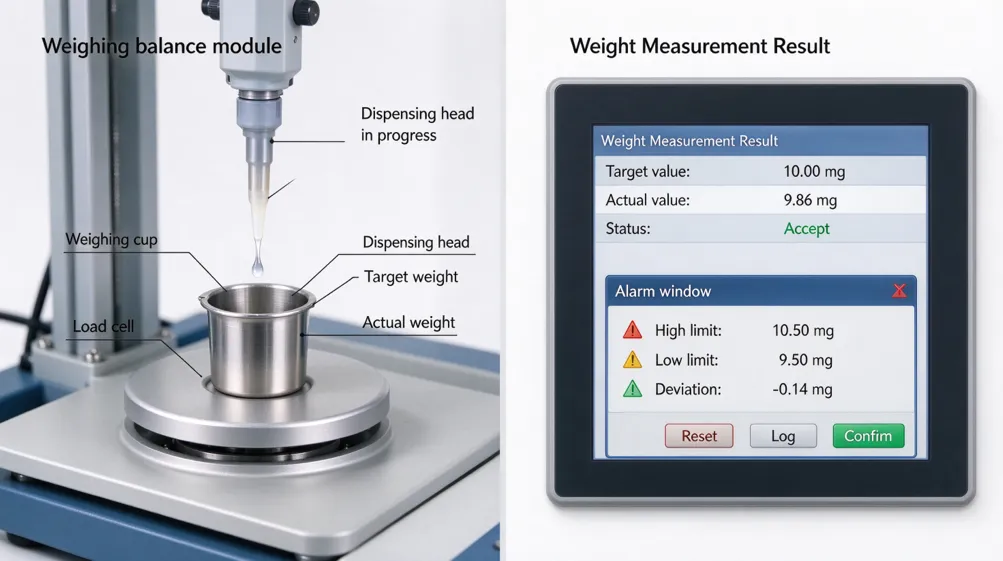
A bead can look correct and still be clearly underweight. The only reliable check is to weigh it. With automatic weighing, the dispensing head moves to a built-in precision scale, dispenses a test shot or a test pattern, and compares the measured weight with the target window you set. If the weight is outside the window, the machine raises an alarm before more parts are affected.
On XINHUA high-speed dispensers you choose when the weighing happens during automatic operation. Typical triggers are:
• At start-up and after every glue change
• After a set number of parts or a set time interval
• After automatic needle cleaning
• After any stop longer than the glue's pot life or open time
Weighing catches the problems operators cannot see: missing glue, insufficient glue and a blocked needle. When the shot weights are recorded, your quality team gets real data for SPC instead of a visual check.
|
Keep in mind that weighing accuracy and motion accuracy are different things. Weighing tells you how much glue came out. Motion accuracy tells you where the needle went. A closed-loop cell needs both, which is why weighing is combined with height sensing and vision. |
Laser height sensing for warped boards and tall parts
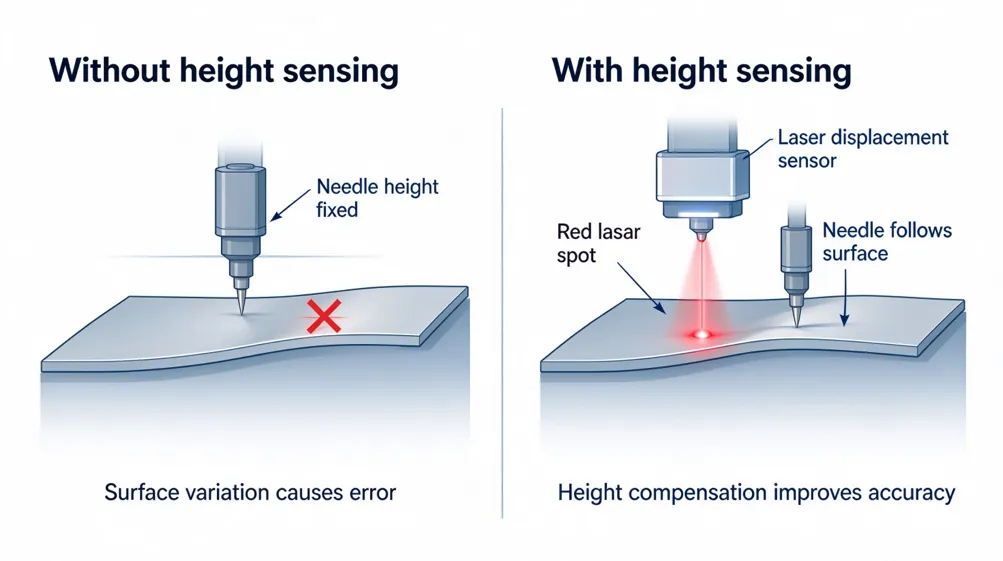
The gap between the needle and the surface decides the shape of the bead. If the needle is too low, it drags through the glue or hits the part. If it is too high, the glue stretches into strings, dots land off target and beads come out thin.
Boards and FPCs are rarely perfectly flat, and fixtures have tolerances. A laser displacement sensor measures the real surface height at set points before dispensing starts, and the machine adjusts the Z height for each part. This keeps the gap constant across a warped board and protects the needle from tall components that sit closer to the head than the program expects.
Height still matters with non-contact jet valves. The jet distance affects where the dot lands and how it spreads, so height sensing is used on jetting machines as well.
Vision needle calibration and crash prevention
Every needle change moves the tip slightly. A tenth of a millimetre is enough to put a dot on the edge of a pad, and a larger offset can crash the needle into the part. Calibration has to be fast, or operators will skip it.
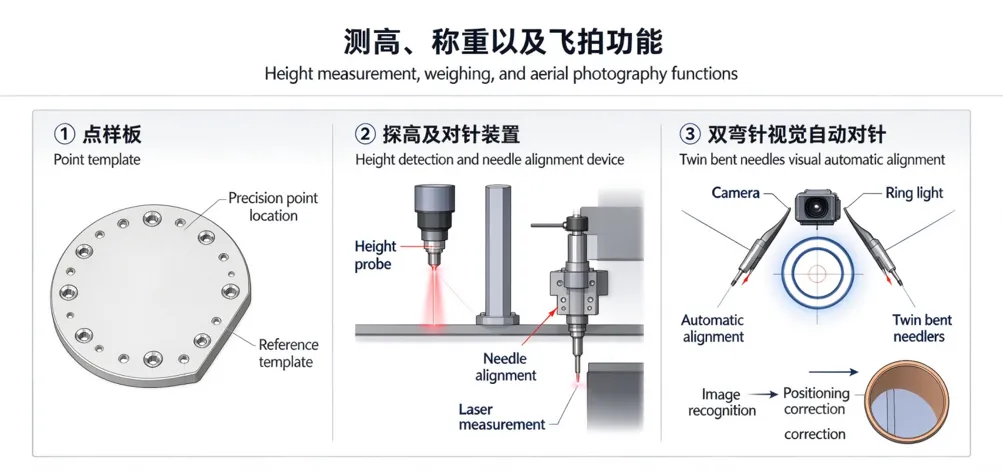
XINHUA dispensers use three tools for this:
• Point template (camera–needle calibration). The machine dispenses a dot on a template and the camera finds it. This confirms the relative position of the needle and the camera, so vision positioning and dispensing use the same reference.
• Height detection and needle alignment device. This calibrates the needle's relative position in X, Y and Z after a change, with no manual measuring.
• Dual bent-needle vision alignment. Bent needles are used to reach under or around components, but their tip angle is hard to set by hand. This vision system corrects the needle angle in real time. It reduces needle crashes and greatly cuts the time lost to line changes and reprogramming.
Automatic tip cleaning and purge
Glue that builds up on the outside of the needle pulls the next dot sideways and slowly closes the tip. With automatic cleaning, you set when the needle is cleaned, and the machine removes residue on its own, with no manual wiping between batches.
After a glue change, a purge (drain) unit lets the valve dispense until the air is cleared from the new material. The unit collects the purged glue, so it is easy to clean, and the first production parts are not used to bleed air from the system.
How the modules close the loop
No single module solves everything. The value comes from combining them so that each one covers a different failure:
|
Problem |
Module |
When it acts |
What it prevents |
|
Volume drift, short shots, clogged needle |
Auto-weighing |
At set intervals during production |
Light or missing beads reaching final inspection |
|
Warpage, fixture tolerance |
Laser height sensing |
Before each part is dispensed |
Wrong bead width, stringing, needle drag |
|
Offset after a needle change |
Needle calibration (point template, alignment device, bent-needle vision) |
After every needle change |
Off-target dots and needle crashes |
|
Residue at the tip |
Automatic cleaning |
At the interval you set |
Dots pulled off target, gradual blockage |
|
Air after a glue change |
Purge unit |
After a material change |
Skipped shots at restart |
Retrofit or new machine? A quick decision guide
If your current dispenser has drift and crash problems, the first question is whether to add modules or replace the machine.
|
Situation |
Usually the better choice |
|
The controller can accept extra I/O and software functions, and there is space on the platform for a scale and sensors |
Ask the original supplier about retrofitting modules |
|
The machine has no vision system, or the software cannot run a weighing or calibration routine |
A new machine is usually cheaper than a deep retrofit |
|
You need recorded weighing data for customer audits |
Choose a machine where weighing data can be logged and read out |
|
Changeovers are frequent and use bent needles |
Prioritize a machine with vision needle alignment |
Where these modules come on XINHUA dispensers
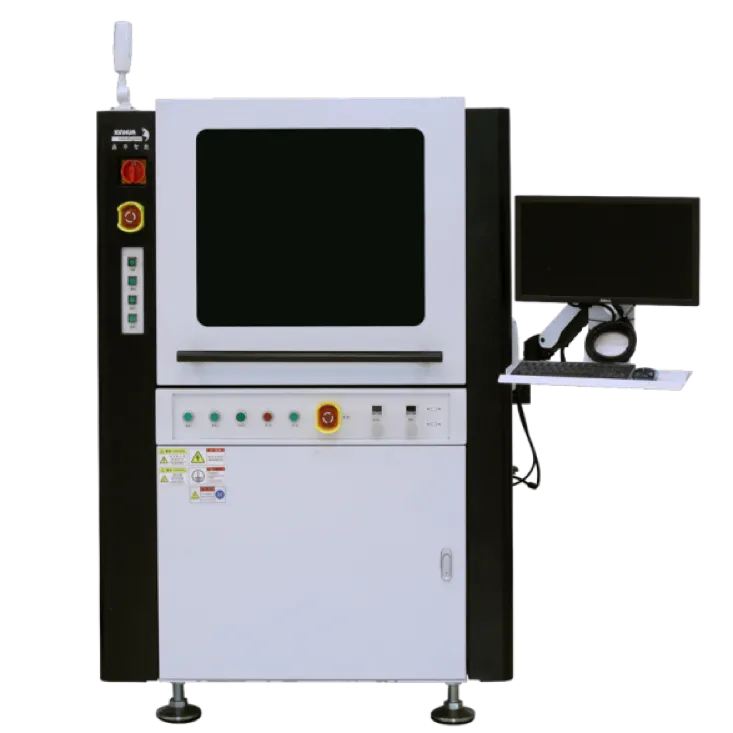
The XY-G550 / XY-G1200 high-speed intelligent dispensers are built for SMT, FPC, 3C, backlight and semiconductor lines. They combine CCD vision positioning with a laser displacement sensor for height measurement, automatic weighing and automatic cleaning, and they can run piezo jet, screw or pneumatic valves.
The XY-1240TM dual-module four-valve dispenser is designed for long, high-count parts such as CCS assemblies. It offers automatic weighing and height measurement, with dual bent-needle vision alignment available.
Module configurations differ by model, and some modules are optional. We confirm the exact configuration in the quotation, based on your product and glue.
FAQ
How often should the dispenser weigh a shot?
It depends on how fast your conditions change and how expensive a bad part is. Common practice is to weigh at start-up, after every glue change and cleaning cycle, and then at a fixed part count during production. Start more often, then reduce the frequency once the data shows the process is stable.
Does laser height sensing slow down the cycle time?
It adds a short measuring step for each part. In most applications this is small compared with the time saved on rework and needle crashes. For high-speed lines, the number and position of measuring points can be optimized during setup.
Can needle calibration work with bent needles?
Yes. The dual bent-needle vision alignment system was developed for this. It corrects the needle angle, which is difficult to set accurately by hand.
Are weighing and height sensing standard or optional?
It depends on the model. Some machines include them as standard, others offer them as options. Check the product page or ask us to confirm the configuration for your application.
Can the machine log weighing data for traceability?
On machines with an open MES communication port, your system can read production data from the dispenser. Tell us which weighing data your customer or quality team needs to see, and we will confirm how it is recorded for your configuration.